

Last updated: October 7, 2026
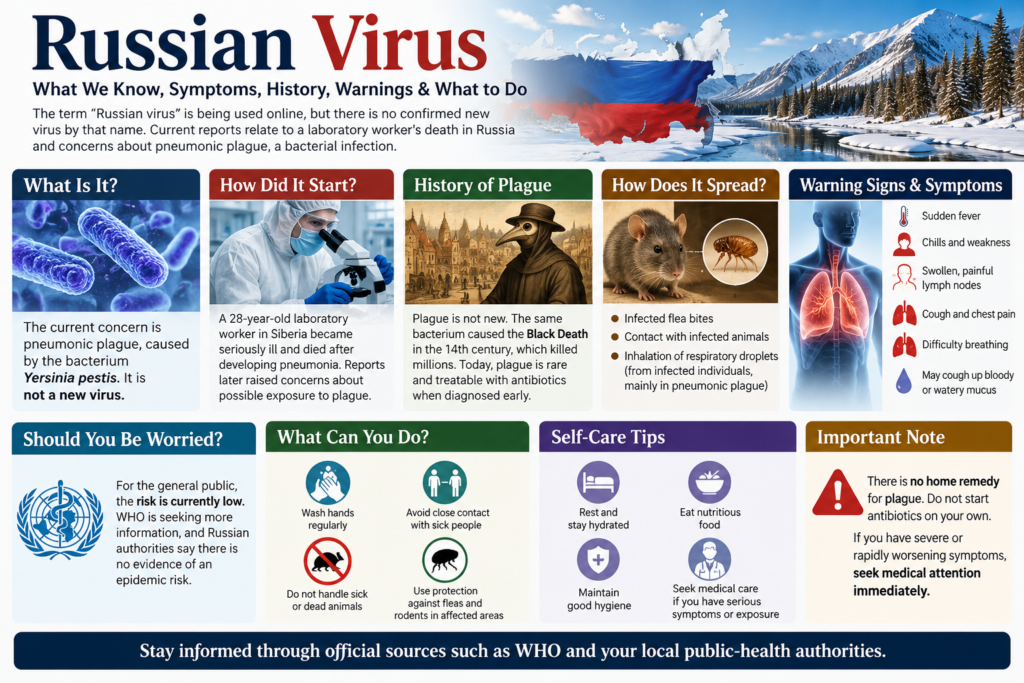
The phrase “Russian virus” has been spreading online following the death of a 28-year-old laboratory worker in Siberia. However, the term is misleading: no new virus officially called the “Russian virus” has been confirmed.
The current health concern revolves around the death of Darya Shipilova, a laboratory worker at the Irkutsk Anti-Plague Research Institute in Siberia, Russia. She passed away on October 2, 2026, due to pneumonia of unknown origin. Russian authorities have stated that no cases of the plague have been identified in Irkutsk, and tests conducted on individuals who had contact with her indicated no presence of dangerous pathogens.
The World Health Organization (WHO) has asked for additional information because the available reports do not yet provide enough clarity about the case. Current assessments do not indicate a large-scale public-health threat, but the investigation remains important because the laboratory specialises in plague and other dangerous infectious diseases.
Is the “Russian virus” actually a virus?
No confirmed disease called the “Russian virus” has been identified.
The phrase appears to be a social-media description rather than the official name of a disease. At present, authorities are dealing with a case of pneumonia of unknown or undetermined origin, while reports and public speculation have raised questions about possible exposure to plague.
That distinction matters because Plague is a bacterial infection caused by Yersinia pestis, not a virus.
Is pneumonic plague confirmed in Russia?
No. Pneumonic plague has not been confirmed as the cause of the laboratory worker’s death.
Russian authorities have reported that there are no confirmed plague cases in Irkutsk. WHO has indicated that it still needs more information, and reporting has noted uncertainty about whether the deceased worker’s own illness was definitively ruled out as plague.
This means it is inaccurate to describe the current event as a confirmed pneumonic plague outbreak.
A more accurate description is:
A Siberian laboratory worker died from pneumonia of unknown origin, while possible plague exposure has been investigated and remains unconfirmed.
What is pneumonic plague?
Pneumonic plague is the lung-based form of plague caused by Yersinia pestis. It is one of the most serious forms of the disease.
Plague is a zoonotic infection, meaning it normally circulates among animals and can spread to humans. The bacteria are commonly associated with small mammals and their fleas. People may become infected through the bite of an infected flea, contact with infected animal tissues or, in the case of pneumonic plague, inhalation of infectious respiratory particles.
Pneumonic plague can also spread from an infected person to another person through respiratory particles, particularly with close contact.
What happened in Siberia?
According to current reporting, Darya Shipilova, 28, worked at the Irkutsk Anti-Plague Research Institute. She became seriously ill and died on October 2 after developing pneumonia of undetermined origin.
Her death led to precautionary measures and the quarantine or monitoring of people who had been in contact with her. Russian health officials have reported that laboratory testing of contacts did not identify dangerous pathogens and have said that there is no epidemic risk.
The case attracted international attention because the institute studies plague and other hazardous infectious diseases, and because of uncertainty surrounding some of the early reports. WHO continues to seek more information.
A brief history of plague
Plague is an ancient disease, not a newly emerging virus.
The bacterium Yersinia pestis was responsible for the historic pandemic known as the Black Death, which caused enormous loss of life in Europe during the 14th century.
Plague still occurs naturally in certain regions of the world, especially where infected animal populations and fleas harbor the bacteria. Unlike in medieval times, however, plague is now a treatable bacterial disease when diagnosed and promptly treated with the correct antibiotics.
WHO reports that human plague cases are now comparatively uncommon and that most reported cases during 2019–2025 occurred in the Democratic Republic of the Congo and Madagascar.
What are the symptoms of plague?
Symptoms of the plague vary depending on its form. One common type is bubonic plague. plague
Common symptoms include:
- Sudden fever
- Chills
- Headache and weakness
- Painful, swollen lymph nodes, known as buboes
Bubonic plague is commonly associated with infected flea bites.
Pneumonic plague
Symptoms can include:
- Fever
- Weakness
- Cough
- Chest pain
- Shortness of breath
- Rapidly worsening pneumonia
- Sometimes bloody or watery mucus
Pneumonic plague can progress very quickly and requires urgent medical attention.
These symptoms can also occur with many other respiratory infections. Symptoms alone cannot confirm plague. Laboratory testing is required.
Should the general public be worried?
Based on the information available on October 7, there is no evidence of a large-scale international outbreak connected to this incident.
WHO has described the current public-health risk as low, while Russian health authorities have said there is no epidemic risk. ECDC is also monitoring the situation and reported no evidence of sustained human-to-human transmission.
That does not mean the investigation should be ignored. It means the available evidence does not currently support treating this as a global outbreak.
Because information is still developing, readers should rely on WHO, national public-health authorities and established medical organisations rather than social-media claims.
How can plague spread?
Plague can reach humans through several routes.
Infected fleas can transmit Yersinia pestis through bites. People can also become infected through contact with tissues or bodily fluids from an infected animal.
Pneumonic plague is different because infectious respiratory particles can allow transmission between people when someone has plague affecting the lungs.
What can you do to reduce your risk?
For people without a known exposure, ordinary infection-prevention measures are appropriate.
Avoid close contact with people who are seriously ill and coughing, wash your hands regularly and avoid handling sick or dead wild animals.
In areas where plague is known to circulate, avoiding flea bites and reducing contact with rodents and potentially infected animals are particularly important.
People who have severe or rapidly worsening symptoms—especially fever with significant weakness, cough, chest pain or difficulty breathing—should seek medical attention promptly.
Tell the healthcare professional about relevant travel or possible exposure if there is a reason to suspect contact with plague.
Is there a home treatment for plague?
There is no proven home remedy that treats plague.
Plague is a serious bacterial infection that requires professional medical assessment and, when confirmed or strongly suspected, appropriate antibiotic treatment.
Do not attempt to treat suspected plague with leftover antibiotics or self-prescribed medication. The correct treatment should be determined by a qualified medical professional. Prompt diagnosis and appropriate treatment are critical.
Rest and adequate fluids may support general comfort while someone is awaiting medical assessment, but they must not replace medical care when a serious infection is suspected. Early diagnosis and appropriate antibiotic treatment are essential because untreated plague can become rapidly fatal. World Health Organization (WHO) — Plague
The bottom line
The term “Russian virus” is misleading.
The current incident in Siberia involves the death of a laboratory worker from pneumonia of unknown or undetermined origin. Concerns about pneumonic plague have been reported, but plague has not been confirmed as the cause of her death, and there is currently no evidence of a large-scale outbreak connected to the incident.
The best approach is awareness without panic: follow official health updates, avoid unverified social-media claims, take sensible infection-prevention precautions and seek prompt medical care for severe or rapidly worsening symptoms.
This article is for general educational purposes only and is not medical advice. Information about the investigation may change as further testing and official statements become available.
